Where Should You Go for Stargazing or to watch the Perseids?

See the tab above that says “Seattle Stargazing“? That’s my most recent list of ideas for you.

The map can be found over on Google Maps as well.

My Perseids news coverage 2015

-Full article at West Seattle Blog.

-Interview on KUOW’s The Record for 8/12/2015.

-365 Days of Astronomy What’s Up Tonight, Southern Skies Edition August 2015 (includes tips on astrophotography)

Alan Boyle’s article at GeekWire about Seattle stargazing spots

~ A l i c e !

March 20 Spring Equinox Sunset Watch — 2018

It’s time for the 36th seasonal sunset watch! (It’s our NINE year anniversary!)

I can’t wait to see you for a reasonably-timed sunset.

  • When: Tuesday, March 20, 2018 at 7:10pm (so come at 6:30/6:45pm)

    • Actual sunset is supposed to be at 7:22pm, but we have noticed that the Sun sets about 10 minutes earlier than the USNO says, because of the horizon altitude.
    • The equinox moment is Tuesday, March 20, 2018 9:15am
  • Where: Solstice Park – all the way up the hill from the tennis courts (or, if you’re not in Seattle, wherever you have a view of the western horizon!)
  • Who: Everyone welcome, as usual. (Please do leash your dogs as we usually have a good number of people, kids, and other dogs around.)
Parent and Child at Sunset by Kazuhiko Teramoto

Parent and Child at Sunset by Kazuhiko Teramoto, skyseeker

Come watch the sunset at Solstice Park in West Seattle. I’ll be there even if it is cloudy because sometimes the Sun peeks through just as it begins to set, but if it is driving rain or a thunderstorm I’m staying home with some tea!

If you’re interested – here’s the timing of various celestial events  from Seattle, courtesy of the U.S. Naval Observatory Astronomical Applications Department:

Sun and Moon Data for One Day

U.S. Naval Observatory
Astronomical Applications Department

Seattle, King County, WA (Longitude W122° 20′, Latitude N47° 38′)

Tuesday, March 20, 2018 Pacific Daylight Time
Sun
Begin civil twilight 6:41 a.m.
Sunrise 7:12 a.m.
Sun transit 1:17 p.m.
Sunset 7:22 p.m.
End civil twilight 7:53 p.m.

Moon
Moonrise 9:07 a.m.
Moon transit 4:02 p.m.
Moonset 11:09 p.m.
Closest Primary Moon Phase: New Moon on March 17, 2018 at 6:12 a.m. (local daylight time)

Phase of the Moon on March 20, 2018: Waxing Crescent with 12% of the Moon’s visible disk illuminated.

This event is my part of the NASA’s Solar System Ambassador program, and thanks to West Seattle Blog for publicizing all of them!

Everyone is welcome, see you there!

~ A l i c e !

What If We Had No Moon? (Oblivion Spoilers)

I was alerted last week to the possibility that people might be asking questions about the scientific possibilities suggested in the movie Oblivion, released today. May I point out that ripping apart the science in movies like this is a form of entertainment for me? If you aren’t interested, go read someone else’s blog.

Shameless plug: You should go see Oblivion at Pacific Science Center in IMAX.

In order to address these issues, I have to talk about the movie, but I’m going to do my best not to spoil the whole thing since you might want to see it.

SPOILER ALERT

.

.

.

SPOILER ALERT

.

.

.

SPOLIER ALERT

.

.

.

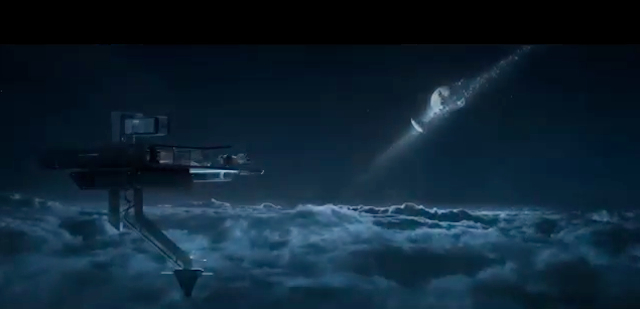
In Oblivion the year is 2077, and the Moon has been destroyed by robot aliens. This caused widespread destruction due to earthquakes and tsunamis. The tectonic activity has stabilized, but humanity has migrated to Titan. A few people are still on earth guarding the Hydro Rigs that convert seawater into energy for the Titan colony. The Moon is depicted as being half there, half a debris ring around the Earth.
Oblivion

Meteorites

Yes, and the movies doesn’t have any.

The method of the Moon’s destruction isn’t dwelled upon in the movie, but I get the impression it was a nuclear war. Let’s just assume the alien race has enough power to blow up the Moon, and they do so.

The first effect is going to be a huge number of meteorites slamming into the Earth. These aren’t going to be just a few that make some pretty craters, that’s a lot of mass up there in the Moon and a lot of it is going to come raining down on the Earth. I think this is going to be the most devastating effect. I’ll have to run some hypothetical math (or maybe Phil Plait or XKCD What-If will do it before me), but it seems like this rain of debris would be significantly more destructive than the meteor that probably killed off the dinosaurs. There will be more mass than that single meteor (a LOT more mass), and it will rain down over more of the planet. I suspect it will be moving more slowly though, so that may mitigate the effect a bit.

Last I heard the dinos died out either because of the ensuing nuclear winter (too much ash and dust in the atmosphere, cooling the climate) or a nearly instantaneous ignition/superheating of most of our atmosphere, which would have broiled everything aboveground leaving burrowing animals and sea-life alone. Whoo-ee. Someone check my references on that. (Jonas? Jonas? Why are you in New Zealand when I need you?). So, the Moon debris falling down would be very bad.

But somehow no meteorites from the lunar explosion.

Earthquakes

Sure. There could be earthquakes if the Moon blew up. Mostly due to IMPACTS FROM METEORITES. Barring those I’m having trouble envisioning why we would get earthquakes from the Moon breaking up in orbit. So my answer is:

Not the way they are in the movie.

The Moon does pull tidally on the Earth’s crust a little bit, but the effects are not the kind that we generally notice over the span of human lifetimes. Even by spreading out the mass of the Moon into more of a ring, you’ll also lose that tidal flex. I would expect that to make fewer earthquakes, not more. In the process of the Earth settling from a shape influenced by the Moon into a shape influenced by the debris ring we will have some earthquakes, but not ones that destroy cities.

If we were Jupiter’s moon Io, and it was Jupiter that was destroyed then yes, we would feel significant tectonic stress. But we’re not.

The Moon’s tidal forces do assist in keeping the Earth’s crust heated, and possibly impact the fact that we have moving tectonic plates in the first place. Now that tectonic plates have formed though, it will take a bajillion years to slow them down and stop them.

Tsunamis

Let’s say yes.

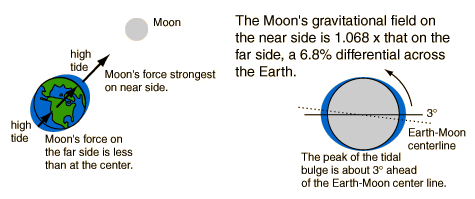
We all know the Moon is the major influencer on our tides here on Earth. The Moon and the Sun share the duties of causing the Earth’s tides, but the Moon does 2/3 of the work, and the Sun only does the leftover 1/3. So there’s a lot of water caught up in the tidal oval at any given time. The Earth rotates through that oval of influence, giving us two high tides per day.

Here’s a diagram of the tidal oval. It’s exaggerated a lot:
tides

From: http://hyperphysics.phy-astr.gsu.edu/hbase/tide.html#stid

That’s a LOT of water to displace, and most of it is at the equator. So if the Moon suddenly disappears, that peak will slosh back down and (after sloshing back and forth a lot) will settle into a more even distribution. With half the Moon still in place, we’ll only be redistributing about 1/3 of that water. Also, since the Moon’s debris is staying in orbit (forming a ring), we won’t need to displace the water towards the poles, it can stay concentrated near the equator. Even though that is a significant reduction, it’s still a lot of moving water, suddenly. That’s a tsunami: a LOT of ocean water being displaced suddenly.

A caveat: it looks in the movie as if those tsunamis carried a lot of sediment with them, enough to cover all but the very top of the Empire State Building. Tsunamis from the destruction of the Moon would have no reason to dredge up sediment from the bottom of the ocean, so I don’t know where it is implied that material came from. I have no problem with the water washing that high in a significant Moon event, but not mud or sand.

A Ring around the Earth

When you first see the movie you’ll say “Alice! That ring is around the Moon, not the Earth.” Just wait, later on it becomes visible as a ring around the Earth.

Yes and no.

I guess that’s my answer for all of these. This is the case where I need to pull out my solar system dynamics textbooks and run through some equations first though.

Yes: soon after the destruction of the Moon, any debris will end up in orbit, and a lot of that will be leading or following the Moon’s own orbit, since that’s where it originated. This will give us a lumpy ring. It won’t be as bright as in the movie, because it will be mostly dust and boulders. Saturn’s ring is very visible because it is mostly very reflective ice. Dust is darker.

Over 60 years (from the Moon’s destruction around 2017 or later until the time of the movie in 2077), some of that debris will have reentered the Earth’s atmosphere, and the rest will also still be orbiting in that ring.

Over a more extended period of time I don’t think the distance of the Moon’s orbit is a stable place for a ring system. The dust will either recoalesce into one or a few Moons, drift to a different orbit, or fall down to the Earth.

I haven’t had time to sit down and calculate any of this out, but these are my reasonably-well-educated guesses.

References

If We Had No Moon, Bernard Foing http://www.astrobio.net/index.php?option=com_retrospection&task=detail&id=2507

Sun’s Tidal Effect http://hyperphysics.phy-astr.gsu.edu/hbase/tide.html#stid

365 Days of Astronomy http://cosmoquest.org/blog/365daysofastronomy/2009/03/28/march-28th/

NASA http://helios.gsfc.nasa.gov/qa_earth.html#quake

.

.

.

SPOILER ALERT

.

.

.

SPOILER ALERT

.

.

.

SPOLIER ALERT

~ A l i c e !

Too Many Meteors? Nah.

Sure seems like we’ve had more than our fair share of bollides this weekend (Russia, Cuba, and San Francisco to name a few). Guess what? I THOUGHT SO TOO. But I was also skeptical. So I asked the scientists I trust* and scientists who specialize in this. They said that we ARE NOT experiencing an apocalypse or really even an increase.

1. Please go read my blogfather, Phil Plait’s, article about this.

The rest of my article is mostly in addition to what he’s already said.

The Frequency Illusion

In popular parlance this is also called the Baader-Meinhof Phenomenon, but the sources on that name are a bit questionable, so I’ll call it the Frequency Illusion.

You know how when you learn a new word, like “brobdingnagian,” suddenly you begin to see that word everywhere? (Perhaps brobdingnagian is a poor choice, it’s just the newest word I’ve learned.) How about The Great Gatsby? I haven’t thought about The Great Gatsby in years and suddenly there’s a new DiCaprio movie coming out and it was jut mentioned in the novel I’m reading. For my husband this week it’s the word “Trypophobia.”

Anyway, that’s the Frequency Illusion. Your mind is keyed into something, and you notice it everywhere. We’ve been hyperaware of asteroids and meteors this weekend, so more people are noticing and reporting the ones that normally occur. The media too is taking special note which is helping us notice these seemingly-extra occurrences.

Coincidence?!

Yes.

The asteroid 2012 DA14 and the spectacular and devastating bollide over Russia are a coincidence. Literally a cosmic coincidence. They are unrelated.

The bollides since then have been a normal part of our everyday lives here on Earth, you just haven’t been noticing them regularly.

Bollides are Normal?

“Alice, I don’t believe you. Are you saying the bollide over Russia was normal? I don’t think hundreds of people are normally injured in sonic booms from meteors in our atmosphere.”

You’re right about that. Fireballs/Bollides/Meteors as large and powerful as the one over Chelyabinsk tend to happen once every 100-ish years. That doesn’t mean there won’t be one tomorrow, or in 50 years. On average they happen once every 100 years.

Fireballs tend to happen for objects about the size of a basketball, and those hit the Earth about once a day. Again, you can easily have two or ten in one day, as well as several days without one, but on average they happen once a day. This is what the meteors over Cuba and San Francisco were: normal daily bollides.

P.S.

Fund the search for near earth objects.

Vocabulary

I see how you might be confused. I’ve used several words interchangeably, and those that I haven’t are minutely different than each other.

  • Comet — an ice and rock body in space.
  • Asteroid — a smallish rocky body in space. Smaller than a planet or a Moon, larger than a house usually.
  • Meteoroid — a tiny rocky object in space, usually sand-sized but up to the size of a house.
  • Meteor — when a meteoroid impacts the Earth’s atmosphere it incinerates. We see them and know them as shooting stars.
  • Meteorite — when a piece of a meteor survives the Earth’s atmosphere and impacts the Earth’s surface.
  • Bollide — an especially bright or exploding meteor. (This is the astronomy definition, the geology definition is different, but doesn’t apply here)
  • Fireball — an especially bright or exploding meteor. (Mm-hmm, pretty much the same as a bollide.)

Want More?

I got my statistics from Yeoman’s Top  Ten on NASA JPL’s Asteroid Watch.

Of course, Phil’s “The Sky is Falling… or is it?” article is also great.

Vocabulary reference from NASA’s Near Earth Object program.

~ A l i c e !

*”Hey Alice, Phil just posted something a day or two ago that he later admitted was wrong. Why do you trust him?” That’s why. Scientists admit when they’re wrong and change their views as the evidence changes. This is harder to do than you might think, so keep practicing. I keep practicing too.

Russian Meteor [Update]

Okay. I trust Phil. He says this isn’t part of the passing asteroid 2012 DA14, and this is why I trust him:

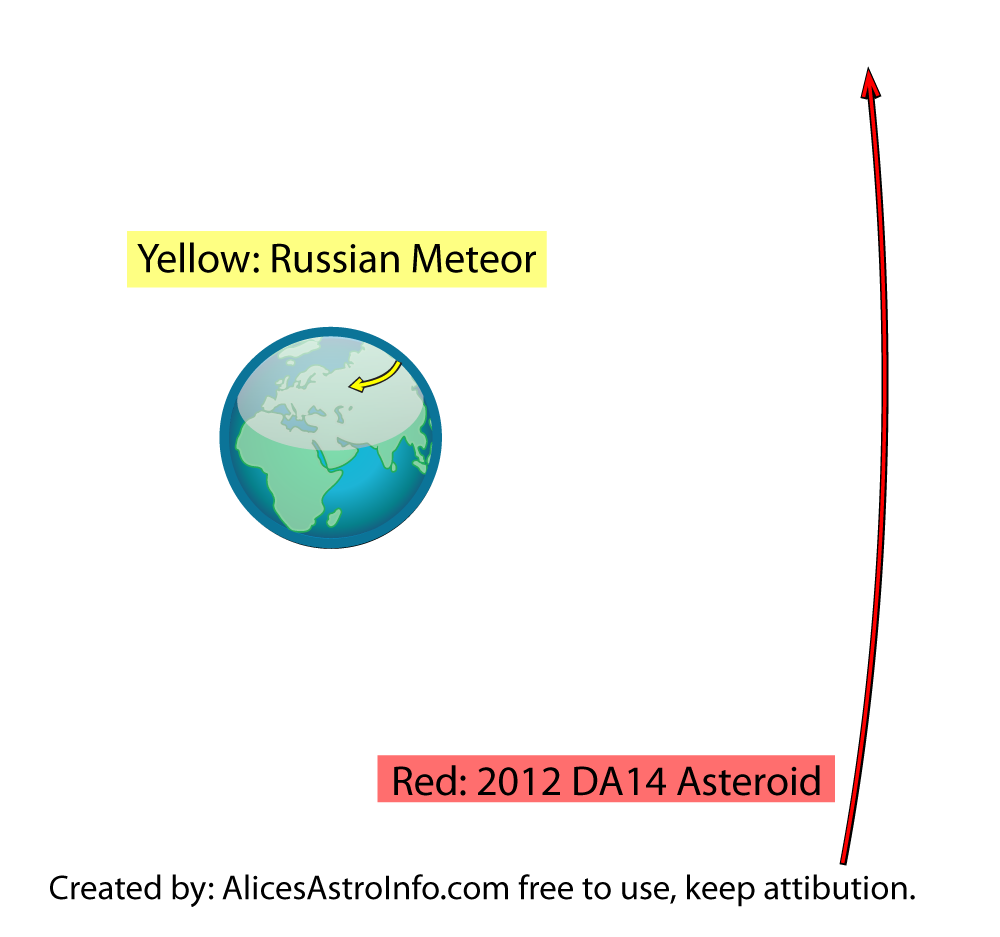
The distance between Earth and 2012 DA14 is approximately correct.  The length of the meteor trail is NOT.

The distance between Earth and 2012 DA14 is approximately correct. The length of the meteor trail is NOT. *

I have tried to be as clear as I can when I created this diagram. The Russian Meteor and asteroid 2012 DA14 have COMPLETELY different paths. The directions are more-or-less correct in this diagram. The length of the meteor trail is too long, but the distance between the Earth and the asteroid is about correct.

This is why I strongly, STRONGLY think the two are unrelated. They’re just plain going different directions.

Okay. Basics:

  • Last night (3:25am UTC 2/15/2013 or 7:25pm 2/14 Seattle) an awesome meteor streaked through the skies in Russia. People (numbers vary between 100-400) were injured because the sonic boom of the meteor broke glass and possibly some buildings. So far (as of 1:34am Seattle time) there has been NO report of a meteor IMPACT. (So it’s a meteor not meteorite until confirmation). There are now likely true reports of impact.
  • The sonic boom set off car alarms as well.
  • There is a spectacular trail in the sky behind the meteor. I, Alice, suspect this is mostly water vapor, just like clouds… but I haven’t done the chemistry on that yet. (Here’s tenuous corroboration.)
  • The trail splits partway through suggesting the meteor did too. Not unusual: just cool.
  • The earliest estimate, according to @Astro_Sailor on Twitter (a friend of an acquaintance) says in-back-of-the-envelope numbers that maybe this is within the realm of 300kg. I’m positive that number will change.

    • New information: “The estimated size of the object, prior to entering Earth’s atmosphere, has been revised upward from 49 feet (15 meters) to 55 feet (17 meters), and its estimated mass has increased from 7,000 to 10,000 tons. Also, the estimate for energy released during the event has increased by 30 kilotons to nearly 500 kilotons of energy released. These new estimates were generated using new data that had been collected by five additional infrasound stations located around the world – the first recording of the event being in Alaska, over 6,500 kilometers away from Chelyabinsk. The infrasound data indicates that the event, from atmospheric entry to the meteor’s airborne disintegration took 32.5 seconds. The calculations using the infrasound data were performed by Peter Brown at the University of Western Ontario, Canada.” — Nasa.gov
  • Not related to the asteroid. See diagram above/attached: mine is the best available.
  • This is also not related to the comets this year.
  • Yes, Russia got the world’s last cool meteor: the Tunguska Event in 1908.

Go read:

1) Phil Plait

2) Emily Lakdawalla

3) Alan Boyle

We all make mistakes, but I trust them and they can help you weed out the real reports from the hoax reports. There are NO flaming craters, but it is an exciting event. Hoping everyone heals up from the falling glass okay.

* Thanks to @AstroGuyz I corrected a misspelling in the original diagram. That’s what I get for blogging at 2am!

~ A l i c e !

Incoming: Asteroid 2012 DA14

An asteroid is going to miss the Earth by a somewhat narrow margin on February 15, 2013 at 11:25am Pacific Time.

What’s Special About This Asteroid Approach?

Closest “Ever”

Just like we keep finding water on Mars, internet commenters wax hyperbolic about the latest meme (“This is the best YouTube video EVAR!”), and we break a local weather record every three months, you can spin anything to be the most ever, the biggest ever, or the closest ever, as long as you add enough qualifiers.

In this case, this is the biggest object1 to get this close to the earth2, since we started doing regular sky surveys in the 1990s3 looking for objects like this. As much as I’ve just knocked down how exciting that is, this is pretty cool. It is going to be close enough to be almost visible.

  1. Smaller objects have been closer. Meteors streak through our atmosphere every day.
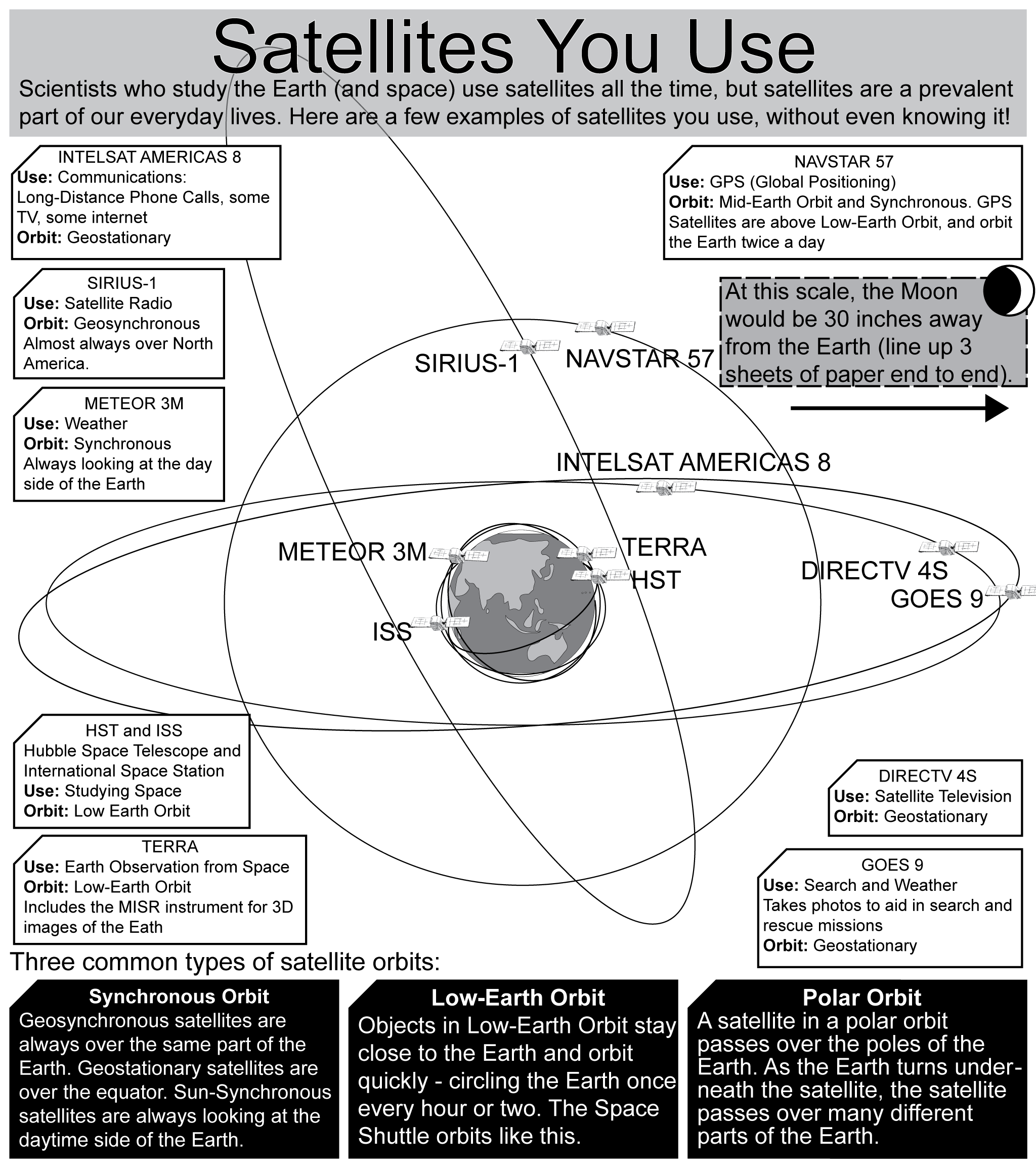
  2. This asteroid is coming in closer than our farthest satellites. In fact, it is closer than a big set of our satellites: the geostationary satellites. Other asteroids you’ve heard of approaching us have been just barely within the orbit of the Moon. Time for a picture or two:

    Satellites-You-Use
    This is a small selection of satellites you use. There are hundreds of satellites in orbit around the Earth, though most of them fall into one of these illustrated orbits. I created the image above, the satellite drawings are not to scale, but the orbits, Earth, and Moon are. Jonas Goodwin drew the satellites for me. Click to make it big enough to read.

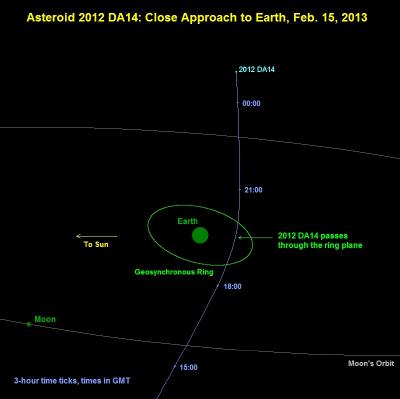
2012da14_s

  1. In the picture just above, the smaller green ring is the same as the larger grey ring (with the DirecTV and GOES satellite) in the “Satellites You Use” diagram above. This asteroid-orbit diagram is from NASA. Click to link over to their website and description.

3. Lucky for you and me, there are people out there looking for asteroids that are going to get close to the Earth. NASA’s Near Earth Object (NEO) program has got your back! Of course, they need more telescope time and more funding to do a complete survey, but they sure are finding a lot of these babies. I, for one, am happy they’re doing their jobs.

Reasonably-sized

2012 DA14 (also known as “this asteroid”) is about 50 meters wide. That’s half an (American) football field, or ten yards longer than the retired Space Shuttle.

According to NASA estimates, this size of asteroid gets close to the Earth about every 40 years, but only impacts the Earth once every 1200 years.

Seeing it

If you want to see this asteroid, your best bet will be to check out NASA’s Goldstone Radar results after February 20th, or search the internet for images obtained by some of the most talented amateur astronomers such as Thierry LeGault, who specializes in taking pictures of fast-moving dim objects.

Unfortunately, here in Seattle it won’t be above the horizon until daytime, so we’re out of luck.

Might 2012 DA14 Hit The Earth?

No.

“2012 DA14 will definitely not hit Earth,” emphasizes Don Yeomans of NASA’s Near Earth Object Program at JPL in the NASA press release of January 28, 2013. “The orbit of the asteroid is known well enough to rule out an impact.”

So, no.

Similar Events

This is the same size meteor that impacted the Earth creating Meteor Crater in Arizona (50,000 years ago), and the same size as the object that exploded just above the Earth’s surface during the Tunguska Event in Siberia in 1908. From these two events we know that a meteorite of this size is destructive, but not catastrophic to the whole world. Their disastrous effect was limited to a few hundred square miles. With notice, we can plan for evacuation of an area that large.


Want More?

NASA Press Release (well written)

Near Earth Object Program Homepage

My old post: Satellites You Use (to give you a sense of scale of where this asteroid is, where our satellites are, and where the Moon is, in relation to the Earth)

Meteor Crater

Tunguska Event (This is awe-striking, read about it)

~ A l i c e !

Geminids at the Seattle Christmas Ship

We saw a couple of Geminids this evening while we were out watching the Christmas Ship at Lowman Beach in West Seattle. (For those of you who don’t know, or those of you not in Seattle, the Christmas Ship is a local tradition that’s been going for 60 years. Argosy cruises takes a choir and a majorly awesome sound system out on a cruise around Seattle. They stop at various beaches where folks are gathered and sing (from afar) Christmas carols at you).

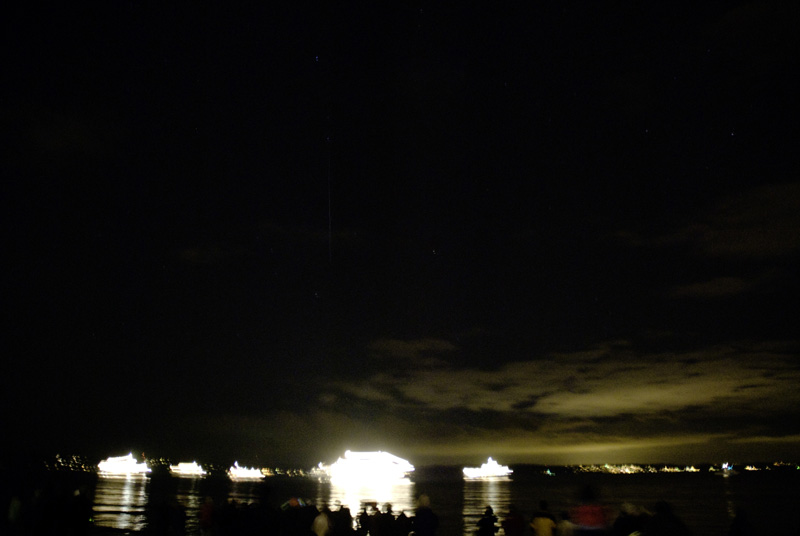
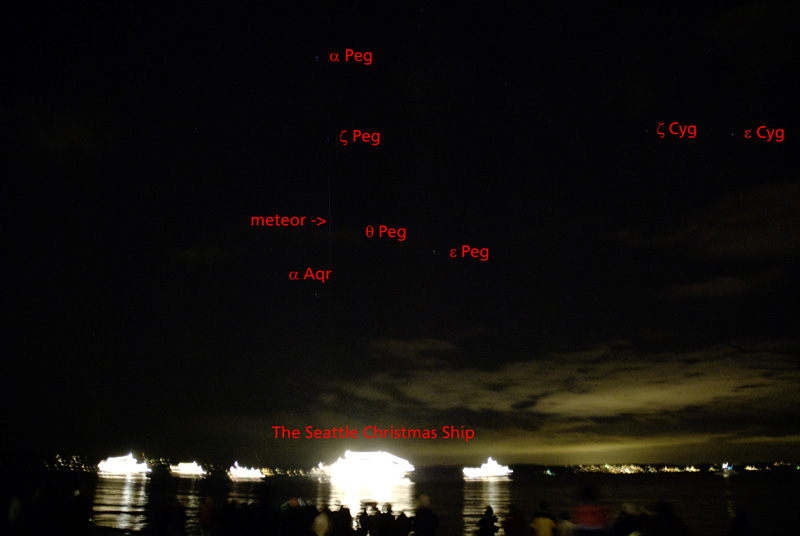
Well, tonight the Geminid meteor shower is peaking. I didn’t even plan to go out looking for them since it is cloudy, but since we were on the beach for the Christmas ship anyway, I looked up and the sky was semi-clear. We each saw about two, with one spectacular one right over the ship itself which made most of the Christmas ship audience ooh and ahh. Jason happened to have his finger on the shutter of his camera and caught it:

Copyright 2009 Jason Gift Enevoldsen

Copyright 2009 Jason Gift Enevoldsen

These pictures are copyright 2009 to Jason Gift Enevoldsen. If you’d like to reproduce them please credit him and let me know (alices astro info at gmail dot com). Click to see bigger.

Here are some helpful labels:

Copyright 2009 Jason Gift Enevoldsen

Copyright 2009 Jason Gift Enevoldsen

Happy meteor-watching!

~ A l i c e !

Quick Updates: Kepler, Saturn, Perseids, Jupiter

Perseids:

The Perseids peak tonight after midnight. They’re dust- and sand-sized debris left in our path from comet Swift-Tuttle. The air compressing in front of each meteor generates enough heat that the debris burns up and we see a streak of light.

Kepler:

The Kepler mission (looking for Earth-like planets around other stars) has just proved it definitely can detect planets, with more detail and precision than other methods. Kepler observed the planet HAT-P-7, which orbits its star once every 2.2 days, and was able to detect the atmosphere of the planet, and measure the daytime temperature at 4310 degrees F. Ouch.

Saturn:

Saturn’s rings are edge-on from our point of view, which happens every 15 years when Saturn reaches its equinox. According to JPL that day was yesterday, August 11, though the rings will stay mostly edge-on for a while yet.

Jupiter:

I’m quite late off the mark on this one, but something crashed into Jupiter not too long ago. On July 19th an amateur astronomy (Anthony Wesley) found this extra dark spot on Jupiter, and later professional astronomers followed up on his observations with Hubble. With Hubble they can watch as the debris plume evolves, and make better estimates about the size of the impacting object (several hundred meters across).

There is a standing hypothesis that Jupiter, being large, helps clean up the debris in the solar system. It attracts more asteroids and comets, leaving the inner solar system clearer and thus making impacts on Earth less likely.

Want More?

Meteors
Saturn Images

Where’d I Get My Info?

Kepler
Saturn
Jupiter

~ A l i c e !

Heat: We’re Doing it Wrong!

Oops. We’ve been teaching meteors wrong. I’ll bet it’s my fault.

The Short:

Meteors do not heat up due to friction with the atmosphere, unlike what our classic hand-rubbing demonstration leads you to believe. They heat up due to compression of the atmosphere. Mostly.

The Story:

So imagine a boat speeding across Lake Washington. See that bow shock, the beginning of the wake, which forms in front of your imaginary boat? That’s kinda what’s happening. Of course, water doesn’t compress (being a liquid), so you get up-and-down waves in water instead of compressed density waves, but gas like an atmosphere is VERY good at compressing, so for our meteor we’ll get nice compression. The speeding meteor-particle (yes, the tiny sand-sized piece of rock) compresses the air in front of it, like the boat’s bow shock.

Bow Shock

Bow Shock

Density Waves:

We talked about density waves a little while ago when we were discussion the galaxy. Instead of up-down or side-to-side waves, density waves are just more stuff or less stuff in a given area. In the case of compression heating, we’re squishing more stuff (air) into a smaller area.

Compression Heating:

When you compress a gas it heats up. Well, almost always. There are some weird cases, but this isn’t one of them. This is classic PV=nRT. What?! Am I allowed to write that on the internet? Yes. This is one of the things you learn early on in a chemistry class that has even a little math in it. Basically the Pressure and Volume of a gas are directly related (=) to the number of atoms, R (just a number), and Temperature. So, if you change one of those things, the others have to change too… oh, and you can’t change n or R.

Alice, I’m not listening anymore:

Okay, come back. This is why a bicycle pump heats up when you’re pumping. It’s not the friction of the little thing inside, it’s that you’re pressurizing gas. This is why aerosol cans (shaving cream, hairspray, those compressed air cans you get for dusting out your computer) cool off when you use them.

The New Way:

You can still do hand-rubbing. Until we come up with a kinesthetic way to teach compression (suggestions?), you might as well – we’re still talking about heat, and that’s a great demonstration of heat. Just mention that it’s not friction that burns up the meteor – it’s compression heating (like a cooling aerosol can).

Alice Enevoldsen

Want More?

Thanks for tipping me off Phil.

Here’s some more from NASA.

Aurigid Meteor Shower

[Watch the Aurigids at]() 4:30am on the night between August 31-September 1, 2007 for an “outburst” of meteors lasting about two hours. (It’s called an “outburst” instead of a “shower” because it’s so short and bright).

Why should I get up at 4:30am**?**

Although we’re only talking about several dozen meteors, these should be some of the brightest ones you’ve ever seen. According to NASA Ames Research Center, we will be looking at meteors brighter than the brightest stars in the night sky.

This is the only predicted meteor shower from a long-period comet (a comet that passes the Sun less than every 100 years or so) in our lifetimes. This is so exciting, cool, and rare that a conglomeration of scientists is going observe the meteors from a plane flying over California during the peak of the shower.

Where are they from?

Comet Kiess circled past the sun some time in the 40 years around 4 C.E., and again in 1911. The dust particles that make the Aurigid meteors are from this comet, but they’re pushed in and out of the Earth’s orbit by the gravitational forces of the Sun and other planets, so we don’t see the meteors every year. The last sightings were in 1935, 1986, and 1994.

Want to be Official?

Take part in the campaign! You can contribute to the study of the Aurigid shower by: recording your visual observations. Count meteors in 1-minute intervals. Do not change viewing direction, keep Moon out of field of view. The Aurigid Meteor Observation Project explains how to use a laptop to do the counting for you. Report your observations to: pjenniskens [at] seti.org.

Want More?

http://aurigids.seti.org/ – More information about the mission, and how you can contribute.

http://leonid.arc.nasa.gov/aurigids.html